Skip to content

How to Extend the Service Life of Aluminum Extrusion Dies
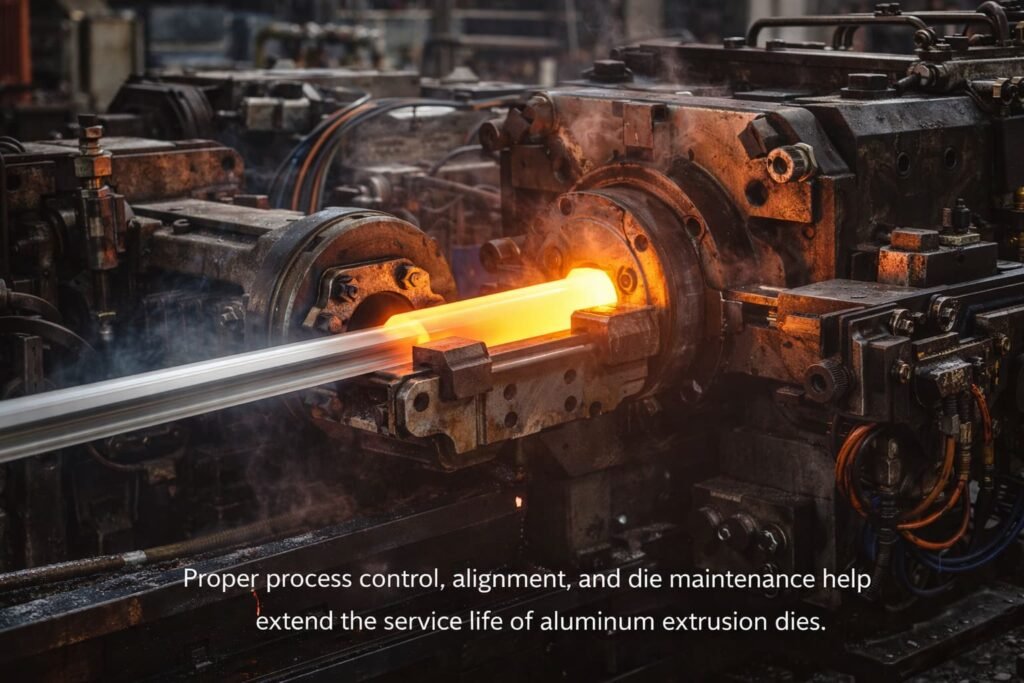
The service life of an aluminum extrusion die has a direct impact on production efficiency, profile quality, maintenance cost, and overall manufacturing stability. In aluminum profile production, die design, process control, and die maintenance are key factors that affect long-term tooling performance.
In actual production, extrusion die life can vary significantly depending on the aluminum alloy, profile structure, die material, heat treatment condition, dimensional requirements, and operating method. Some dies may only remain usable for a limited number of runs, while others can stay in service much longer when they are applied and maintained correctly.
Why Die Life Matters in Aluminum Extrusion
During production, aluminum extrusion dies are exposed to temperature, pressure, alignment changes, material flow variation, support conditions, and operator handling. For this reason, die life should not be viewed only as a material issue. It is also closely related to process discipline, installation accuracy, repair quality, and production feedback.
To improve die life and maintain stable extrusion performance, manufacturers should focus on the following practical points.
1. Follow the Aluminum Extrusion Process Strictly
The aluminum extrusion process should be carried out according to the required production parameters. Stable billet heating, controlled temperature distribution, and sufficient soaking time are important for both die protection and profile consistency.
During startup, billet heating should be controlled carefully to ensure that the aluminum billet reaches a sufficiently uniform internal and external temperature. If the billet core temperature is not properly balanced, the difference in thermal condition may increase elastic deformation of the die, which can lead to profile imbalance, uneven material flow, and, in severe cases, plastic deformation or die damage.
2. Maintain Proper Alignment of the Extrusion System
To achieve stable extrusion, the center of the extrusion container, the center of the extrusion stem, and the center of the die base should remain properly aligned. In production, this is usually treated as a critical concentricity requirement throughout the extrusion setup.
If significant eccentricity exists, material flow across the section may become unstable, resulting in unequal profile length, dimensional deviation, or more serious profile imbalance. Accurate alignment is therefore essential for both die life and product quality.
3. Use Support Pads Correctly
Proper use of support pads can help reduce elastic deformation of the lower die and improve extrusion stability. For suitable profile applications, the support pad size and structure should be selected according to the die type and product requirement.
Before the die is released for production, the required support pad arrangement should be prepared in advance. This helps avoid problems caused by delays or by excessive die cooling during handling, which may otherwise affect forming stability and production consistency.
4. Check Die Condition and Prevent Damage
Die damage may result from material selection, assembly, operation, adjustment, and maintenance. To improve die life, the following risks should be checked carefully:
- Improper die material selection: If the selected die material is not suitable for the actual working condition, the die may deform, corrode, or wear excessively after a period of use.
- Improper installation or disassembly: If die parts are struck during assembly or disassembly, components may deform and working surfaces may be damaged.
- Improper taper angle design: If the taper angle is too large, metal flow resistance may increase and sensitive die areas may fail prematurely.
- Insufficient working surface hardness: If the hardness of the die or mandrel working surface is too low, severe wear may occur and lead to unstable profile quality.
- Setup and adjustment errors: Improper adjustment may damage screws, deform the die or sizing sleeve, and prevent the die from operating correctly.
5. Strengthen Production Feedback During Extrusion
Production feedback is essential for correct die maintenance and repair. In many cases, die problems cannot be judged accurately unless the extrusion condition is described clearly and consistently. This is especially true when a die shows blockage, flow imbalance, or dimensional instability.
When reporting die issues, the die number should be clearly identified, and the material flow direction and defect condition should be recorded as accurately as possible. If the extrusion head shows visible imbalance, the feedback should indicate whether one side flows faster or slower, whether the two sides behave differently, or whether one side becomes longer than the other during extrusion.
For dimensional problems, if the profile forms normally but falls outside tolerance, a marked sample should be taken and identified clearly, including the die number, extrusion direction, and defect location. Inaccurate or unclear marking may lead to the wrong die being repaired, which wastes time and increases unnecessary trial work.
Why Accurate Feedback Helps Extend Die Life
Complete and accurate production feedback helps repair personnel identify the real cause of a problem more efficiently. This improves repair effectiveness, reduces unnecessary die trials, and lowers the total number of repeated repairs.
In practical extrusion production, die life is improved not only by better materials or higher hardness, but also by stronger process control, correct installation, accurate alignment, and more useful production feedback.
Tooling and Production Support from FITMOLD
FITMOLD supports custom tooling development and manufacturing projects that require practical engineering evaluation, controlled production workflow, and stable long-term tooling performance. For projects involving profile tooling, die structure, and production-oriented manufacturability, early review of process requirements and operating conditions is especially important.
If you are looking for a manufacturing partner for custom tooling and production support, FITMOLD can support your project from design review to tooling and production.
Contact us: sales@fitmold.com