
Key Characteristics and Precision Control in Grinding Machining
Grinding is a high-precision machining process widely used for finishing hardened materials, improving surface quality, and achieving tight dimensional tolerances. Compared with other cutting methods, grinding involves a more complex material removal mechanism, higher energy consumption, and greater sensitivity to machine rigidity, grinding force, and heat generation.
Because of these characteristics, grinding plays an important role in precision manufacturing, mold making, and high-accuracy component finishing.
1. Grinding Is More Complex Than General Cutting
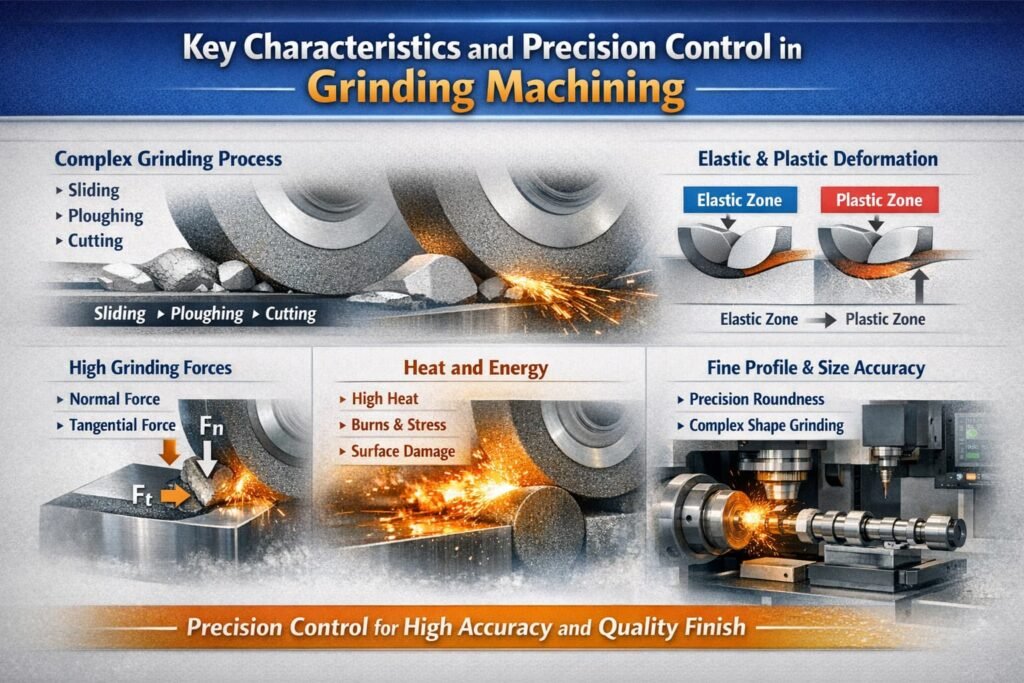
The grinding process is more complicated than ordinary cutting because each abrasive grain on the grinding wheel may go through three different states during machining:
- Sliding
- Ploughing
- Cutting
In actual grinding production, the grinding wheel process is generally divided into three stages:
- Spark-out cutting
- Stable grinding
- Spark-out finishing
This makes grinding behavior more complex than turning, milling, or drilling, and requires more careful control of process conditions.
2. Elastic and Plastic Deformation Have a Major Influence
During grinding, both elastic deformation and plastic deformation are relatively large compared with many other machining methods. These deformations directly affect:
- Dimensional accuracy
- Surface roughness
- Grinding heat generation
- Surface integrity
- Grinding efficiency
In practical production, it is important to understand the critical conditions where the contact zone changes from elastic deformation to plastic deformation, and then from plastic deformation to actual cutting.
3. Grinding Force Differs from General Machining
Grinding force behaves differently from conventional machining forces. In general machining, tangential force is usually the main cutting force. In grinding, however, the normal force is often about 2 to 4 times greater than the tangential force.
The grinding force is mainly made up of two components:
- Cutting force
- Friction force
In rough grinding, cutting force is dominant. In fine grinding, friction force becomes more significant. Because of this, the rigidity of the entire grinding system has a strong influence on process stability, dimensional control, and surface finish.
4. Grinding Generates High Energy and Heat
Grinding is an energy-intensive machining method. In many cases, the energy consumed in grinding can be much higher than in ordinary machining processes.
This means that grinding heat and temperature rise must be controlled carefully, because excessive heat can cause:
- Surface burns
- Dimensional variation
- Residual stress
- Microstructural damage
- Reduced surface quality
Proper coolant application, wheel selection, dressing condition, and grinding parameters are essential for heat control.
5. Fine Grinding Ensures Size, Roundness, and Profile Accuracy
Fine grinding is often used to guarantee dimensional accuracy, roundness, and contour precision on high-accuracy parts.
Improving Roundness
To improve the roundness of a part, the blank itself must not have excessive roundness error or concentricity error before grinding begins.
Controlling Dimensional Accuracy and Roughness
To maintain final dimensional accuracy and surface roughness, manufacturers must pay close attention to changes in grinding force. When a grinding wheel is newly replaced, instability usually increases. For this reason, wheel condition must be monitored carefully, and grinding wheel maintenance and replacement should be managed properly.
Profile Grinding of Complex Shapes
When grinding curved profiles such as cam shapes, changes in the contact trajectory between the workpiece and grinding wheel can cause variations in grinding force. This may reduce process stability and lead to profile errors.
On standard cam grinding machines, these effects can be difficult to control. In comparison, insert grinding methods and controlled forming motion on coordinate grinding machines can reduce these problems significantly.
This is one of the reasons why coordinate grinding is often used in precision mold manufacturing, especially for parts that require high contour accuracy and stable geometric control.
Why Grinding Matters in Precision Manufacturing
Grinding is a critical finishing process for precision components because it provides excellent dimensional control, fine surface finish, and accurate profile correction. However, its complexity also means that grinding requires careful control of deformation, force, heat, machine rigidity, and wheel condition.
When properly managed, grinding can greatly improve machining precision and help produce high-performance parts for tooling, molds, and other demanding industrial applications.